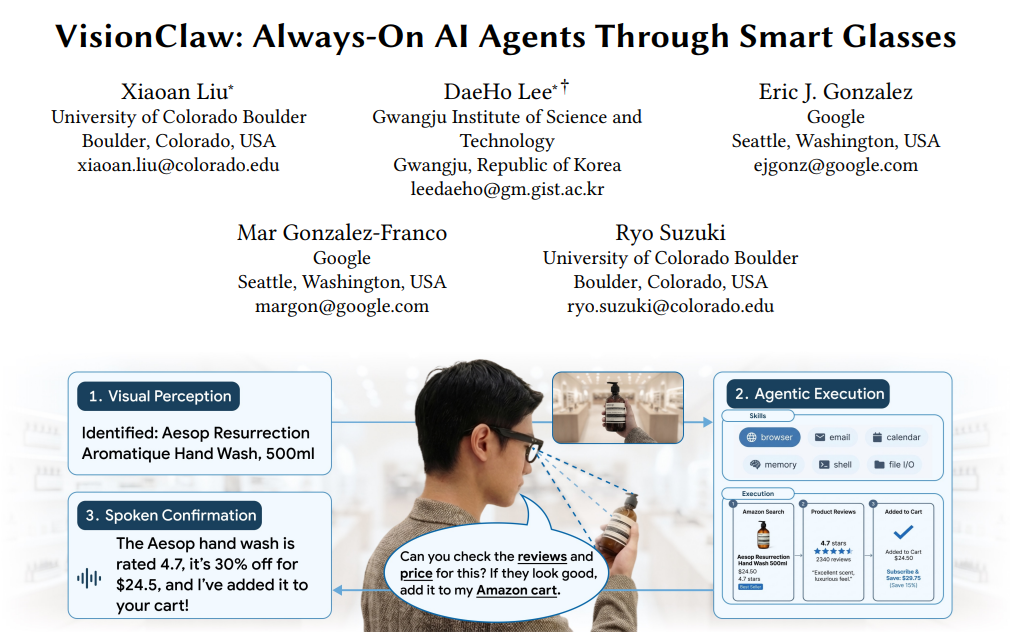
 If you do not believe that the future is smartglasses + AI, the VisionClaw paper might change your mind.
The authors created a system that “running on Meta RayBan smart glasses, continuously perceives real-world context and enables in-situ, speech-driven action delegation via Gemini Live and OpenClaw AI agents.” Paper’s description of a (small; N=4) deployment study is fascinating in its demonstration of how agentic interaction changes everyday behavior.
I’ve always believed in augmented reality – obviously! – but this is just a whole other level of opportunities for AR and AI.
Full text of the paper on ArXiv
About Maria Gorlatova
Dr. Maria Gorlatova is the Sternberg Family Associate Professor of Electrical and Computer Engineering at Duke University. Her research centers on pervasive computing technologies, with a focus on spatial computing and next-generation augmented reality. She received her Ph.D. in Electrical Engineering from Columbia University and her M.Sc. and B.Sc. degrees (Summa Cum Laude) in Electrical Engineering from the University of Ottawa, Canada. She spent two years at Princeton University’s Electrical Engineering Department as an Associate Research Scholar and Associate Director of the Princeton University EDGE Lab. Dr. Gorlatova was named one of the N2Women Rising Stars and has received multiple awards, including the NSF CAREER Award, the DARPA Young Faculty Award (YFA), the DARPA Director’s Fellowship, the IEEE ISMAR 2025 Best Paper Award, the IEEE Communications Society Award for Advances in Communications, and research awards from Meta, Cisco, and IBM. She served as the TPC Co-chair of ACM/IEEE IPSN 2023, the General Co-Chair of the 2025 NSF Workshop on Networking and Systems Challenges in Immersive Computing, and the TPC Co-chair of ACM/IEEE SenSys 2025.

 If you do not believe that the future is smartglasses + AI, the VisionClaw paper might change your mind.