Possible at Last: Using Large Multimodal Models to Evaluate and Secure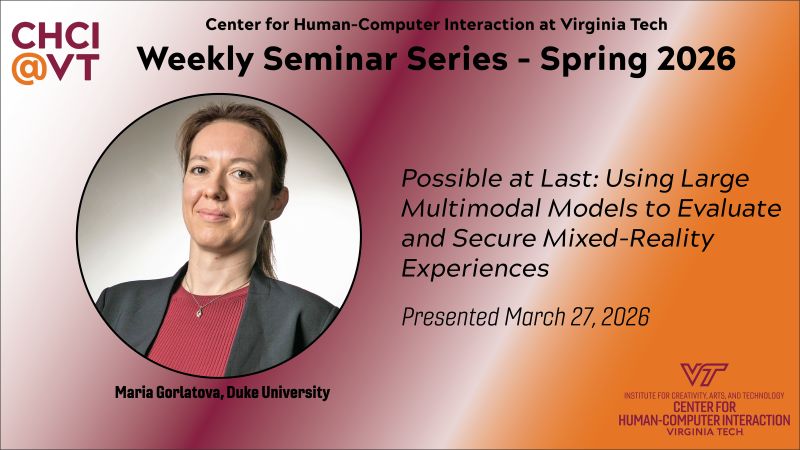 Mixed-Reality Experiences – this was the title of the talk I gave as part of the VT Center for Human-Computer Interaction Seminar. Sincere thanks to the organizers for the opportunity to share my perspective: we are finally, finally at the cusp of being able to provide real-time oversight of AR experiences.
Currently, AR operates in “open loop” configurations, without steps that oversee an experience once it is rendered. In important, safety-critical deployments, this will not do: the technology will not get adopted at scale until its performance can be monitored in real time. With LMMs, we finally have a roadmap for providing exactly the kind of oversight that is required to enable such deployments.
Sincere thanks to the CHCI@VT organizers for giving me an opportunity to speak at the seminar!
About Maria Gorlatova
Dr. Maria Gorlatova is the Sternberg Family Associate Professor of Electrical and Computer Engineering at Duke University. Her research centers on pervasive computing technologies, with a focus on spatial computing and next-generation augmented reality. She received her Ph.D. in Electrical Engineering from Columbia University and her M.Sc. and B.Sc. degrees (Summa Cum Laude) in Electrical Engineering from the University of Ottawa, Canada. She spent two years at Princeton University’s Electrical Engineering Department as an Associate Research Scholar and Associate Director of the Princeton University EDGE Lab. Dr. Gorlatova was named one of the N2Women Rising Stars and has received multiple awards, including the NSF CAREER Award, the DARPA Young Faculty Award (YFA), the DARPA Director’s Fellowship, the IEEE ISMAR 2025 Best Paper Award, the IEEE Communications Society Award for Advances in Communications, and research awards from Meta, Cisco, and IBM. She served as the TPC Co-chair of ACM/IEEE IPSN 2023, the General Co-Chair of the 2025 NSF Workshop on Networking and Systems Challenges in Immersive Computing, and the TPC Co-chair of ACM/IEEE SenSys 2025.