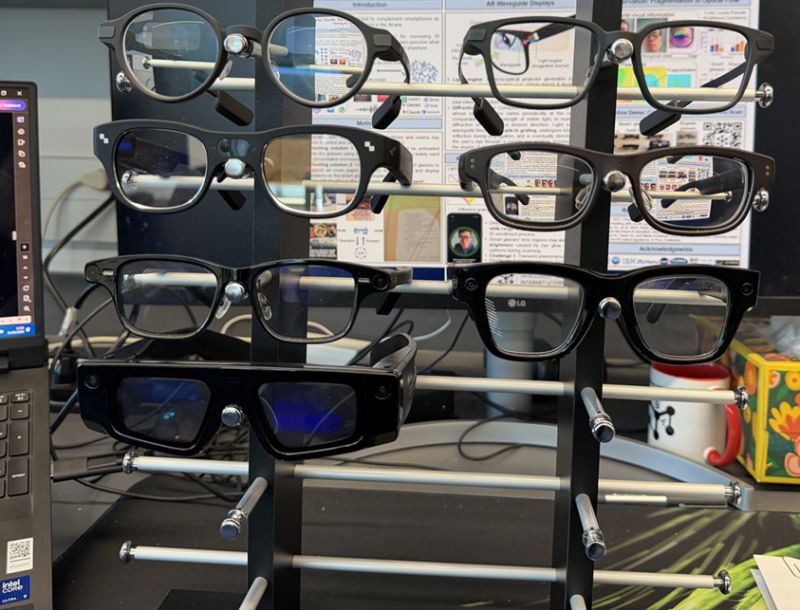
You would think that you are visiting an optician to select a frame for your new prescription. But this is a technology showcase: all of these are smart glasses, connected, on the backend, to powerful audio- and video-understanding AI models, offering a myriad of important AI-based support and oversight functionalities.
Incredible things have been happening in the world of smart glasses, thanks to the AI revolution. Long restricted to costly, niche use cases, they are on the cusp of becoming an everyday gateway to AI – in a good way! Not “you get more targeted ads” type of AI, but “have I secured my child’s car seat properly?” type of AI.
In smart glasses hardware, a sea of options and opportunities. My Duke lab alone already has 7 (seven!) different models, with different capabilities — see the photo of our new smart glasses display rack. We used to think that in the future everyone would be wearing the same type of an AR headset. The future looks different now: it seems more likely that different types of smart glasses will all exist at the same time, side by side, serving different needs and offering different tradeoffs.
About Maria Gorlatova
Dr. Maria Gorlatova is the Sternberg Family Associate Professor of Electrical and Computer Engineering at Duke University. Her research centers on pervasive computing technologies, with a focus on spatial computing and next-generation augmented reality. She received her Ph.D. in Electrical Engineering from Columbia University and her M.Sc. and B.Sc. degrees (Summa Cum Laude) in Electrical Engineering from the University of Ottawa, Canada. She spent two years at Princeton University’s Electrical Engineering Department as an Associate Research Scholar and Associate Director of the Princeton University EDGE Lab. Dr. Gorlatova was named one of the N2Women Rising Stars and has received multiple awards, including the NSF CAREER Award, the DARPA Young Faculty Award (YFA), the DARPA Director’s Fellowship, the IEEE ISMAR 2025 Best Paper Award, the IEEE Communications Society Award for Advances in Communications, and research awards from Meta, Cisco, and IBM. She served as the TPC Co-chair of ACM/IEEE IPSN 2023, the General Co-Chair of the 2025 NSF Workshop on Networking and Systems Challenges in Immersive Computing, and the TPC Co-chair of ACM/IEEE SenSys 2025.