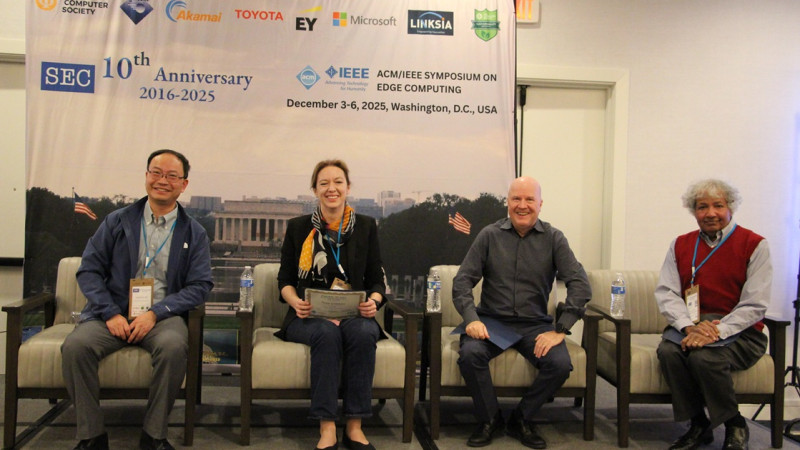
It was my genuine pleasure to get to share my thoughts about the past and future of edge computing at the ACM Symposium on Edge Computing 2025 panel, “Looking Back and Moving Forward: 10 Years of Edge Computing.”
My highest-level takeaway: we are entering the era of human-facing, intelligent spatial systems. Edge computing is inevitable: as computing systems incorporate more real-time AI and more embodied agents, such as robots, the edge becomes not a nice-to-have but a true necessity. Interactive, human-facing, semantically aware computer systems simply cannot reach the right level of responsiveness without it. But, will we do the right thing and use edge for good? There is a nightmare scenario in which today’s buggy, insecure, and privacy-compromising systems spread into more and more aspects of our day-to-day lives. Is this the world we want to leave to our children? We need to commit to doing better.
Slides of my panel presentation
About Maria Gorlatova
Dr. Maria Gorlatova is the Sternberg Family Associate Professor of Electrical and Computer Engineering at Duke University. Her research centers on pervasive computing technologies, with a focus on spatial computing and next-generation augmented reality. She received her Ph.D. in Electrical Engineering from Columbia University and her M.Sc. and B.Sc. degrees (Summa Cum Laude) in Electrical Engineering from the University of Ottawa, Canada. She spent two years at Princeton University’s Electrical Engineering Department as an Associate Research Scholar and Associate Director of the Princeton University EDGE Lab. Dr. Gorlatova was named one of the N2Women Rising Stars and has received multiple awards, including the NSF CAREER Award, the DARPA Young Faculty Award (YFA), the DARPA Director’s Fellowship, the IEEE ISMAR 2025 Best Paper Award, the IEEE Communications Society Award for Advances in Communications, and research awards from Meta, Cisco, and IBM. She served as the TPC Co-chair of ACM/IEEE IPSN 2023, the General Co-Chair of the 2025 NSF Workshop on Networking and Systems Challenges in Immersive Computing, and the TPC Co-chair of ACM/IEEE SenSys 2025.