Duke ECE is featuring my perspective on the role of AI in AR of the future, and on the dire need to employ AI to safeguard the AR of the future, as part of its Faculty Voices: Physical AI series. Full article is available here: A Real-Life J.A.R.V.I.S. Needs a Watchdog. A tidbit from the write-up:
Just a few years ago, I brought my first child home from the hospital and found myself stumbling through the dark nursery trying to shush and ready a bottle at the same time. At that moment, I could easily envision an augmented reality system helping me navigate unfamiliar terrain: working newborn accessories that were not yet familiar while avoiding the many trip hazards with no lights on.
That kind of Physical AI technology, I believe, is just around the corner.
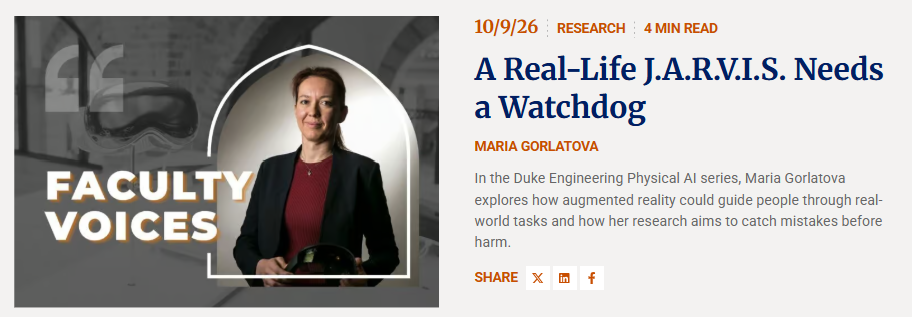
About Maria Gorlatova
Dr. Maria Gorlatova is the Sternberg Family Associate Professor of Electrical and Computer Engineering at Duke University. Her research centers on pervasive computing technologies, with a focus on spatial computing and next-generation augmented reality. She received her Ph.D. in Electrical Engineering from Columbia University and her M.Sc. and B.Sc. degrees (Summa Cum Laude) in Electrical Engineering from the University of Ottawa, Canada. She spent two years at Princeton University’s Electrical Engineering Department as an Associate Research Scholar and Associate Director of the Princeton University EDGE Lab. Dr. Gorlatova was named one of the N2Women Rising Stars and has received multiple awards, including the NSF CAREER Award, the DARPA Young Faculty Award (YFA), the DARPA Director’s Fellowship, the IEEE ISMAR 2025 Best Paper Award, the IEEE Communications Society Award for Advances in Communications, and research awards from Meta, Cisco, and IBM. She served as the TPC Co-chair of ACM/IEEE IPSN 2023, the General Co-Chair of the 2025 NSF Workshop on Networking and Systems Challenges in Immersive Computing, and the TPC Co-chair of ACM/IEEE SenSys 2025.