
In 2025, two Duke I3T Lab members received their PhDs and moved on to exciting careers in industry: Dr. Sarah Eom joined Exponent as a Biomedical Engineering Consultant; Dr. Lin Duan joined NVIDIA as an XR-AI Engineer. There were several exciting developments in the careers of our alums, too: Dr. Ying Chen joined Penn State University as an Assistant Professor. We enjoyed getting to catch up with her at IEEE VR and ACM VRST 2025.
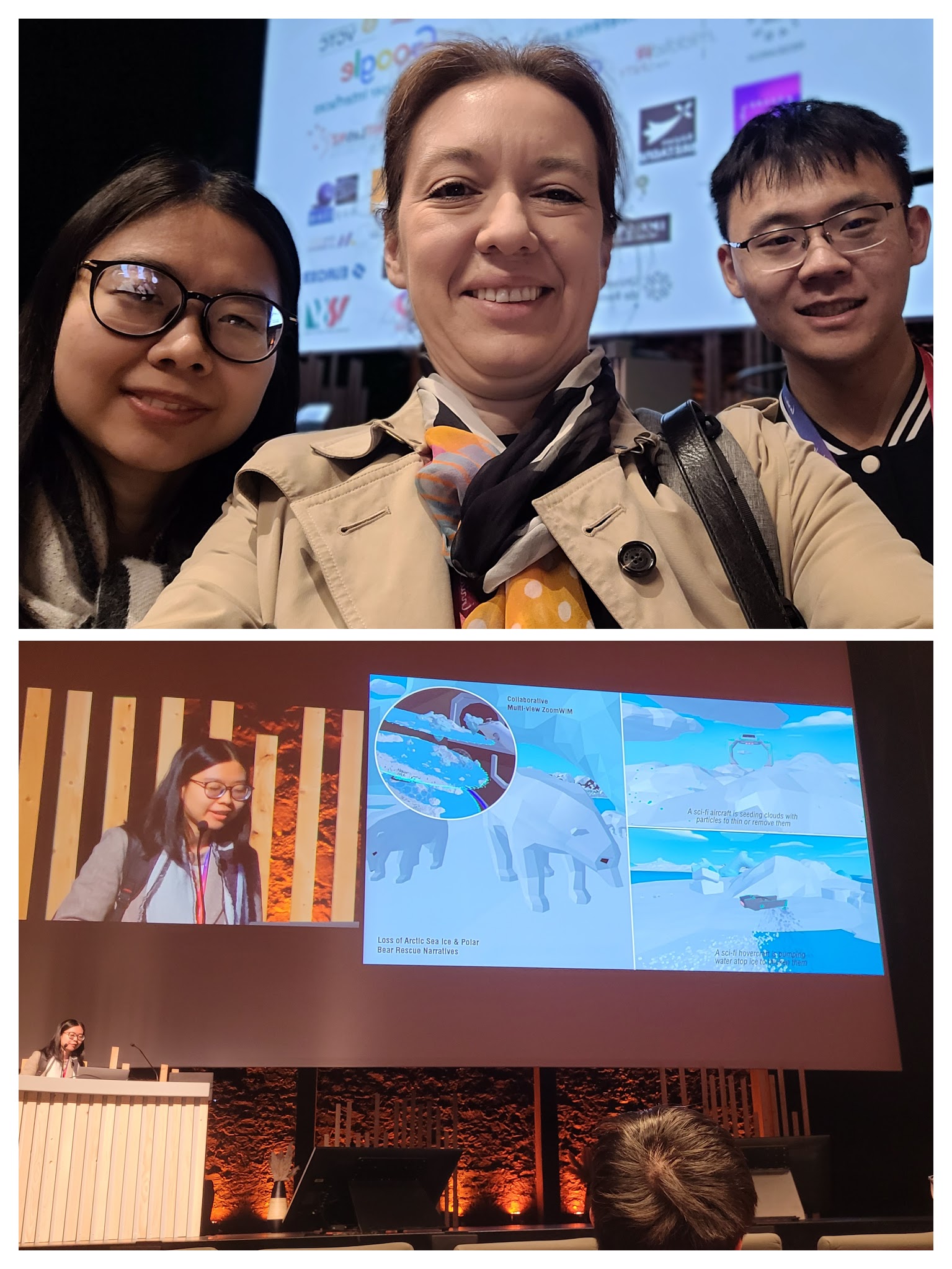
Duke I3T Lab at IEEE VR 2025. Proud advisor moment: sitting in the audience while my former PhD student presented work from her own research group.
Duke I3T Lab members published across multiple key venues, including IEEE TVCG, IEEE VR, IEEE ISMAR, ACM VRST, AACL Findings, and IEEE Internet Computing, and received multiple awards. Yanming Xiu received the IEEE ISMAR Best Paper Award, the IEEE ISMAR Doctoral Consortium Best Presentation Award, and Duke ECE Research Retreat Best Presentation Runner-up recognition. Under Yanming’s guidance, lab’s high-school affiliates Joshua Chilukuri and Shunav Sen received the 2025 IEEE Universal Augmented Interaction Workshop Best Paper Award.
This year also brought important new support for our work. The $743K NSF TIP Breaking Low Award will support our work on low-latency multi-user XR for rehabilitation. The $250K DARPA Director’s Fellowship will allow us to expand our effort in runtime oversight of AR experiences.
We also filed two Duke invention disclosures, one on detecting information-manipulative virtual content in AR, and one on XR exergames for ICU physical rehabilitation. The rehabilitation disclosure grew out of our expanding collaboration with the Duke School of Nursing (DUSON) on immersive technologies for patient-centered care, recovery, and clinical deployment. In 2025, this collaboration led to a paper in CIN: Computers, Informatics, Nursing, an IEEE XR Health workshop paper, and a paper that has recently been accepted to IEEE VR 2026.
I gave multiple invited talks about our work: at AWE USA, Ohio State University, the Conference on Next-generation Computing, Communication, Systems and Security (NSysS), and two DARPA Intrinsic Cognitive Security program PI meetings. I was also absolutely thrilled to share my thoughts about the past and future of the field at the ACM Symposium on Edge Computing panel “Looking Back and Moving Forward: 10 Years of Edge Computing.”
Last but not least, this was a year of important community contributions. I served as the TPC Co-chair for ACM SenSys 2025, co-founded and co-chaired the ACM Workshop on Enhancing Security, Privacy, and Trust in Extended Reality Systems, and co-led a breakout session focused on edge AI and low-power computing at the 2025 NSF CSR PI meeting. I am grateful to everyone who contributed to these efforts and excited to keep building welcoming, rigorous, and forward-looking communities around trustworthy XR systems, edge AI, and human-facing spatial intelligence.
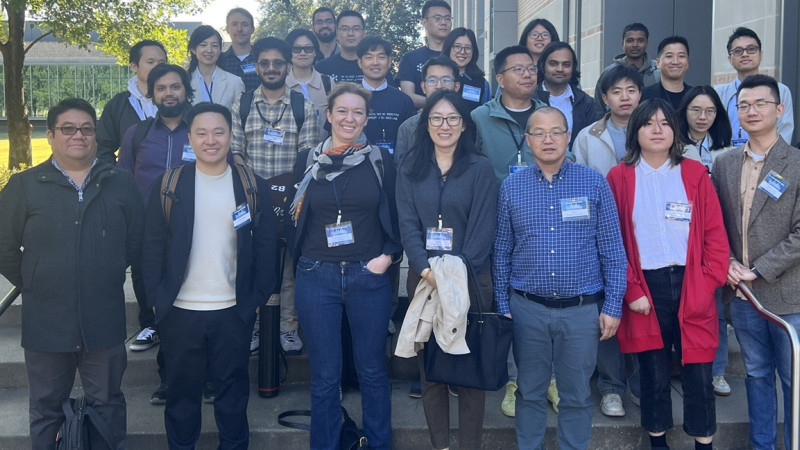
PI Gorlatova organized the 1st Workshop on Enhancing Security, Privacy, and Trust in Extended Reality (XR) Systems, jointly with Prof. Bin Li (PSU) and Prof. Ming Li (UT Arlington).