Sarah Eom has demonstrated our ongoing work on AR-based magnification for hand-held loupes at ACM SenSys’22 in Boston, MA. This work is based on a collaboration with Miroslav Pajic (Duke ECE) and Majda Hadziahmetovic (Duke Ophthalmology). [Demo description PDF] [Accompanying poster PDF]
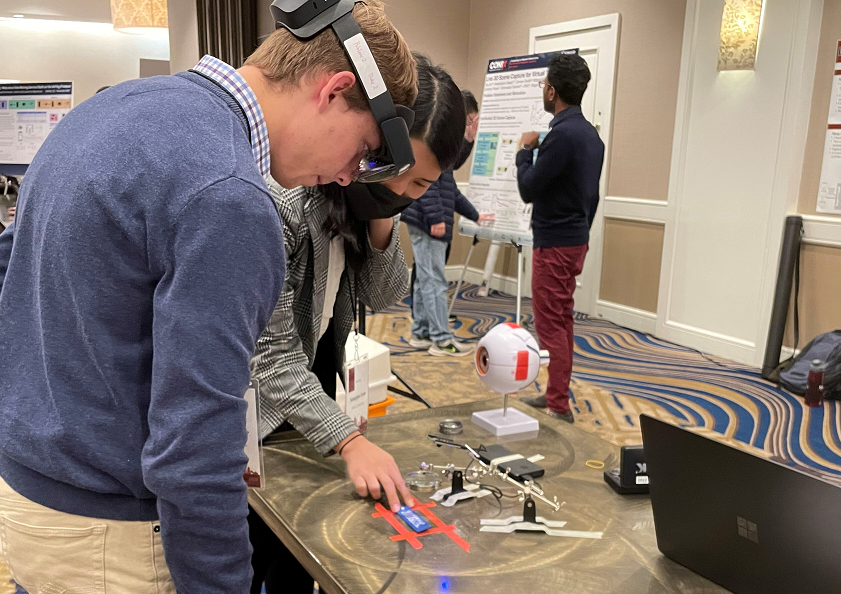
Several systems that rely on AR to show to the user the magnified view of a scene as a whole have previously been showcased (they can, for instance, be very helpful for people who have low vision). Complementary to that, our work considers a scenario where a specific part of the scene is of interest to the user, who wants to examine it with a magnifying lens — as is often important in examination of different historical artifacts, detailed assembly tasks, and microsurgery. For such cases, we demonstrate the first real-time system that projects the hologram onto the magnifying lens itself, with the correct location and scale. The current demo showcases our overall framework. In our next steps, we will be applying the developed framework to retinal laser therapy, in which surgeons use hand-held magnifying lenses to target specific retinal areas of the patients.
About Maria Gorlatova
Dr. Maria Gorlatova is the Sternberg Family Associate Professor of Electrical and Computer Engineering at Duke University. Her research centers on pervasive computing technologies, with a focus on spatial computing and next-generation augmented reality. She received her Ph.D. in Electrical Engineering from Columbia University and her M.Sc. and B.Sc. degrees (Summa Cum Laude) in Electrical Engineering from the University of Ottawa, Canada. She spent two years at Princeton University’s Electrical Engineering Department as an Associate Research Scholar and Associate Director of the Princeton University EDGE Lab. Dr. Gorlatova was named one of the N2Women Rising Stars and has received multiple awards, including the NSF CAREER Award, the DARPA Young Faculty Award (YFA), the DARPA Director’s Fellowship, the IEEE ISMAR 2025 Best Paper Award, the IEEE Communications Society Award for Advances in Communications, and research awards from Meta, Cisco, and IBM. She served as the TPC Co-chair of ACM/IEEE IPSN 2023, the General Co-Chair of the 2025 NSF Workshop on Networking and Systems Challenges in Immersive Computing, and the TPC Co-chair of ACM/IEEE SenSys 2025.