Yes, I did it!
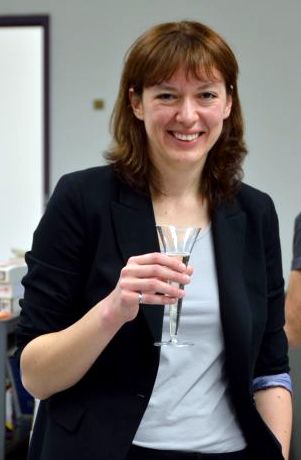
Wednesday April 24th, 4pm EST, following a presentation attended by many of my fellow WimNet group members and coauthors from other groups, and following an intense and engaged period of questioning by the committee, I was pronounced Dr. Gorlatova. It was exhilarating. An exciting culmination of a 5-year Ph.D. journey and a wonderful ending of a brutal semester with a relentless series of deadlines.
Many thanks to my committee members, Professors Chaintreau, Kymissis, Maxemchuk, and Mitra. Unending thanks to my adviser, Professor Zussman, for all his support throughout the last 5 years. Many thanks to all my coauthors and colleagues throughout the years, with very special thanks to John Sarik, Aya Wallwater, Andrey Bernstein, Robert Margolies, Baradwaj Vigraham, Jianxun Zhu, Marcin Szczodrak, Mina Cong, and Sonal Shetkar.
To all the Ph.D. students out there — keep reaching for that rainbow!
About Maria Gorlatova
Dr. Maria Gorlatova is the Sternberg Family Associate Professor of Electrical and Computer Engineering at Duke University. Her research centers on pervasive computing technologies, with a focus on spatial computing and next-generation augmented reality. She received her Ph.D. in Electrical Engineering from Columbia University and her M.Sc. and B.Sc. degrees (Summa Cum Laude) in Electrical Engineering from the University of Ottawa, Canada. She spent two years at Princeton University’s Electrical Engineering Department as an Associate Research Scholar and Associate Director of the Princeton University EDGE Lab. Dr. Gorlatova was named one of the N2Women Rising Stars and has received multiple awards, including the NSF CAREER Award, the DARPA Young Faculty Award (YFA), the DARPA Director’s Fellowship, the IEEE ISMAR 2025 Best Paper Award, the IEEE Communications Society Award for Advances in Communications, and research awards from Meta, Cisco, and IBM. She served as the TPC Co-chair of ACM/IEEE IPSN 2023, the General Co-Chair of the 2025 NSF Workshop on Networking and Systems Challenges in Immersive Computing, and the TPC Co-chair of ACM/IEEE SenSys 2025.