
Being a total data geek, I keep detailed digitized training logs that go back to December of 2009. I write down what I did – in running, cycling, hiking – everything, – and how it felt, keep track of benchmark times and my concerns about them. I also keep track of key summary statistics and analyze them with MATLAB scripts I’ve perfected over the years (told you I was a data geek). These logs tell many stories – of sports performance, and also of work, life, travel, adventures, occasional real stupidity ( you ran a fast mile in the middle of a long run and three days later somehow your shin hates you, huh! – well, I wonder why that is… ) – a trove of marvelous longitudinal data.
One of the patterns I discovered in this data is the wonderful effect I’m going to be calling the “5th week bliss”. The 5th week bliss is a 5th week of a dedicated new training program when everything seemingly magically comes together. During the first 4 weeks of training, you notice some changes in this and that, but they are fleeting, disjoint, and not definitive. And then, in week 5, you catch a glimpse of yourself in the mirror – and notice that your body shape is now different. The stride starts to feel more fluent and begins to look more coordinated, the times of benchmarking activities change dramatically, and so does their feel – old performance barriers start to lose relevance, but you already get a preview of the new ones. Even the appetite changes – its an over-encompassing body-rebuiliding magic. Something to enjoy intensely while it lasts, and something to remember and foresee when struggling with the first few weeks of a new program. The magic will happen – on the 5th week, no sooner and no later.
I am on week 5 of Hal Higdon’s advanced marathon training program and I’ve loved every single run I did this week. Magic, I’m telling you. Total magic.
Data-geeking:
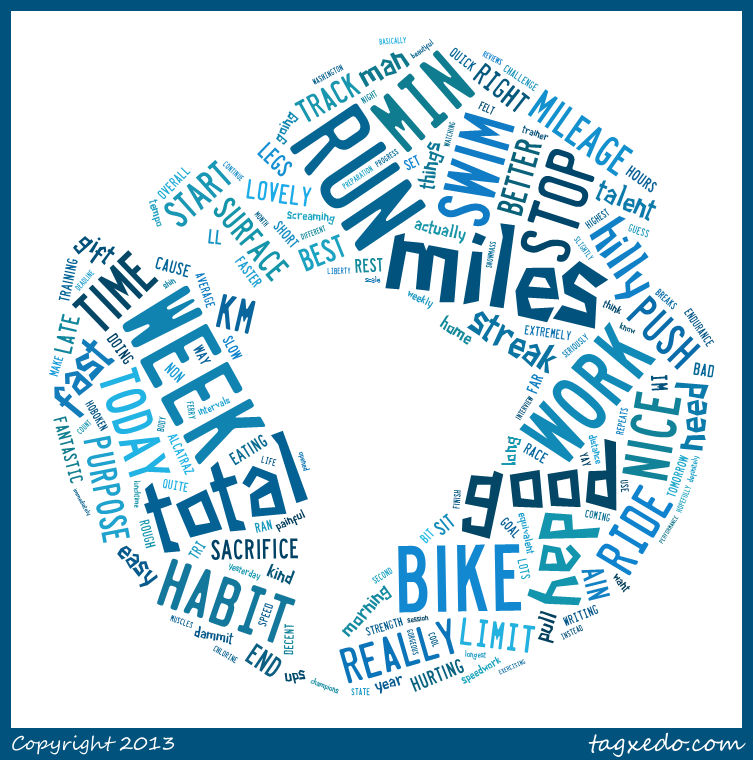
Word cloud of the training log, 2012-2013.
Weekly running mileage, year 2012.
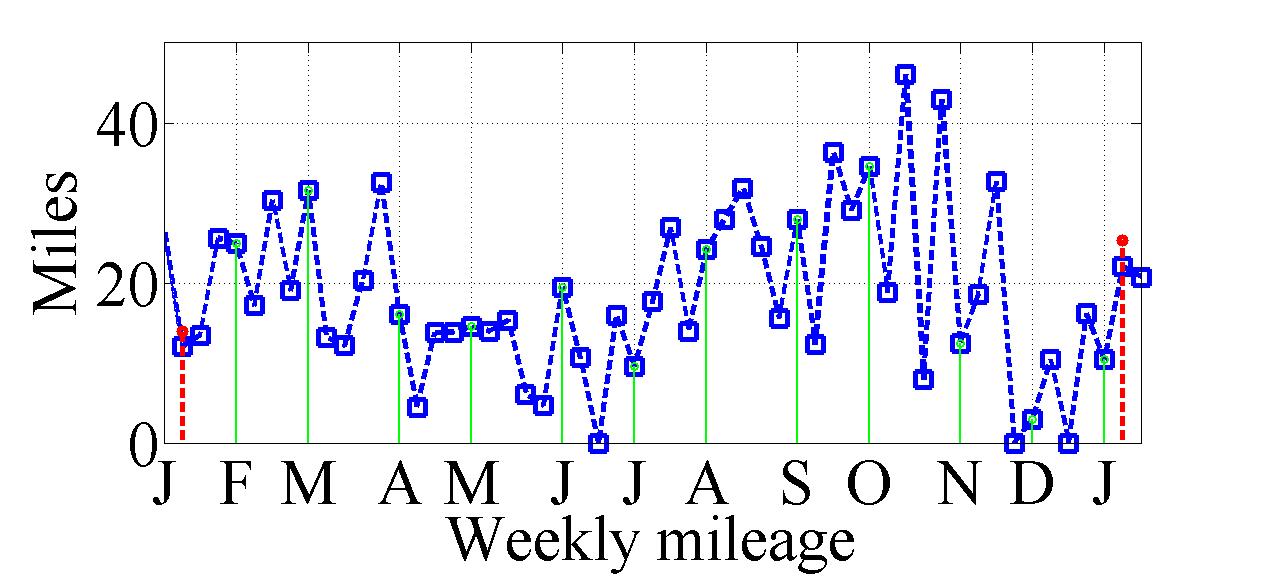
April and May are all about triathlons, hence running mileage is quite low. September and October are preparation for the Philadelphia Marathon.
P.S. Having analyzed the recorded mileage through and through, I am now starting to wonder whether any particular conclusions can be reached from the non-numerical data. Does the appearance of the word “good” correspond to higher mileage in subsequent weeks? Does a hurting shin always follows a set of “meh” kind of runs? There must be patterns, and I’ll find them! Stay tuned!