
Two demos developed in the lab were presented at ACM SenSys’19 in New York City, NY, in November 2019.
A demo led by Joseph DeChicchis, titled Adaptive AR Visual Output Security Using Reinforcement Learning Trained Policies, demonstrates how reinforcement learning-based policies for hologram positioning perform on Magic Leap One augmented reality sets. This demo builds on the work on learning for hologram positioning in AR led by Surin Ahn, previously evaluated via simulations alone. Joseph’s trip to present this demo at ACM SenSys was partially supported by an ACM SIGMOBILE Travel Grant and by a Duke University Undergraduate Research Office Travel Grant. [Video of the demo] Related work:
- S. Ahn, M. Gorlatova, P. Naghizadeh, M. Chiang, Personalized Augmented Reality Via Fog-based Imitation Learning, in Proc. IEEE Workshop on Fog Computing and the IoT, Apr. 2019 (co-located with IEEE CPS-IoT Week). [Paper PDF] [Imitation learning demo] [Extended version of the paper]
- S. Ahn, M. Gorlatova, P. Naghizadeh, M. Chiang, P. Mittal, Adaptive Fog-based Output Security for Augmented Reality, in Proc. ACM SIGCOMM VR/AR Network Workshop, Budapest, Hungary, Aug. 2018. [Paper PDF]
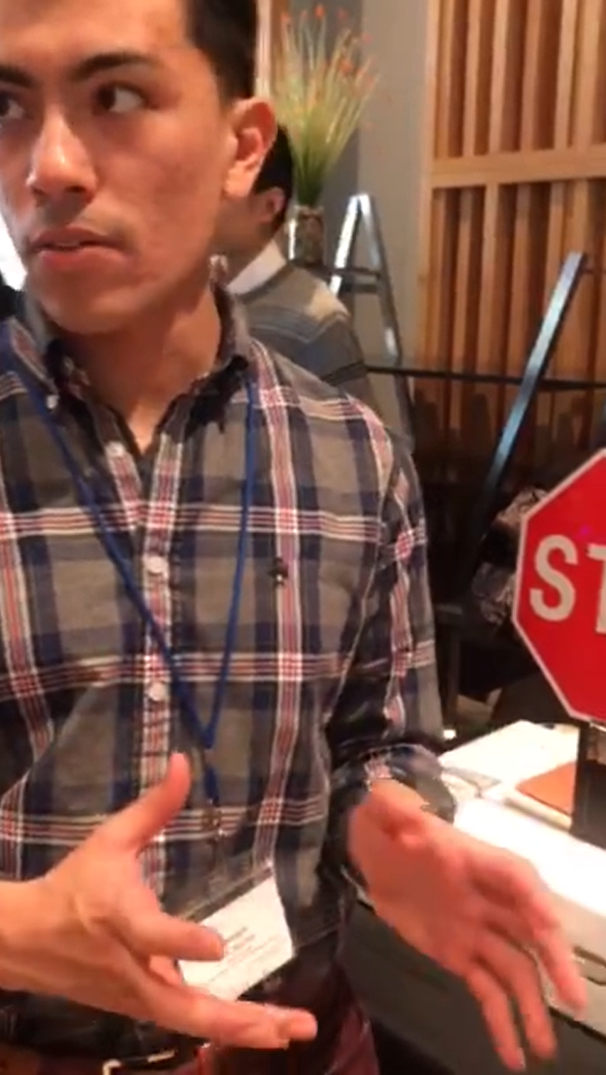 Joseph demonstrating how a reinforcement learning-trained policy can move holograms out of the way of a stop sign.
Additionally, a demo led by Jovan Stojkovic, Zida Liu, and Guohao Lan, titled Edge Assisted Collaborative Image Recognition for Augmented Reality, presents a dynamic approach for handling heterogeneous multi-user visual inputs for image recognition in augmented reality, demonstrated on an edge computing-assisted Google ARCore platform. [Video of the demo]
Demo references:
[SenSys19a] J. DeChicchis, S. Ahn, M. Gorlatova, Demo: Adaptive Augmented Reality Visual Output Security Using Reinforcement Learning Trained Policies, in Proc. ACM Conference on Embedded Networked Sensor Systems (ACM SenSys’19), New York City, NY, Nov. 2019. [Demo abstract PDF] [Video of the demo]
[SenSys19b] J. Stojkovic, Z. Liu, G. Lan, C. Joe-Wong, M. Gorlatova, Demo: Edge-assisted Collaborative Image Recognition for Augmented Reality, in Proc. ACM Conference on Embedded Networked Sensor Systems (ACM SenSys’19), New York City, NY, Nov. 2019. [Demo abstract PDF] [Video of the demo]